
Executive Summary
The regulatory framework for the biogas and renewable energy sector establishes a comprehensive ecosystem to scale up bioenergy production through feedstock security, market integration, and financial incentives. Methane is important component among other gas streams CO2, H2S. To ensure a reliable feedstock supply of CBG plants, Solid Waste Management Rules mandate municipal waste segregation at the source, while agricultural policies ban crop stubble burning to unlock abundant biomass available for onsite anaerobic digestion/fermentation facility. Operationally, the National Policy on Biofuels drives demand with aggressive blending targets for 2030, and the Motor Vehicle Act formally integrates Bio-CNG/CBG as a mainstream commercial transport fuel. Financial viability is bolstered by regulated levelized tariffs for grid-connected plants, alongside capital expenditure relief through concessional duties and a preferential 5% GST rate. Furthermore, government initiatives like the SATAT scheme mitigate market risks by providing off-take guarantees through Oil Marketing Companies, which are strongly supported by direct Central Financial Assistance (CFA) and market-based clean development mechanisms (CDM) such as carbon credits and Renewable Energy Certificates (REC). These schemes provide opportunity to rural people for revenue generation along employment structure. Traditional separation methods are severely constrained by extreme energy requirements, raw material costs, pressure driven constraints prompting a major industry push toward next-generation membrane-based molecular sieving technologies.
Market Overview
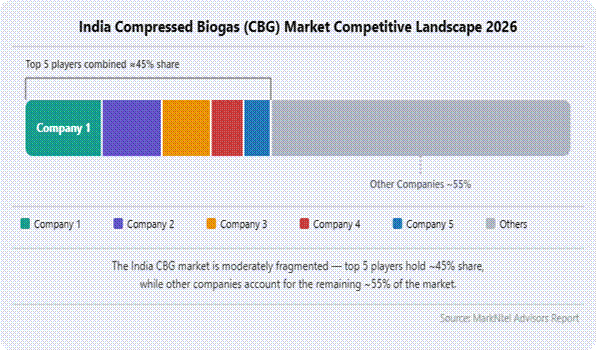
The India Compressed Biogas (CBG) market is expanding rapidly, valued between USD 0.31 billion and USD 2.45 billion, with projections to reach over USD 2.4 billion by 2032. The India compressed biogas market is moderately fragmented, with the top five companies estimated to account for approximately 45% of the market. Reliance Bio Energy, Indian Oil, BPCL, Adani Total Energies Biomass, and HPCL benefit from strong investment capacity, feedstock access, infrastructure, and established gas distribution networks, while specialized players such as EverEnviro, GPS Renewables, Thermax, Praj, and Verbio strengthen competition through technology and project development.
Technology Introduction
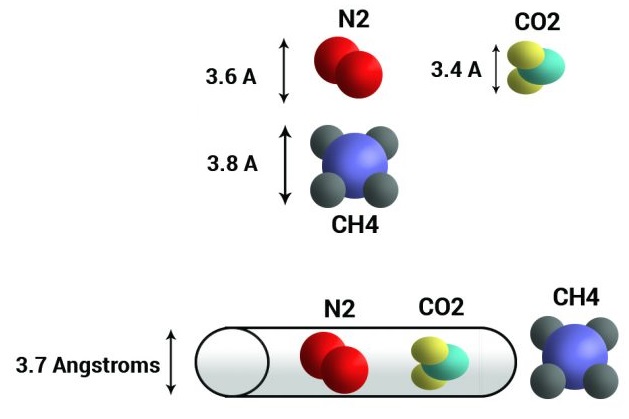
There is a great need for robust, defect-free, highly selective zeolite thin-film membranes within upgradation of biogas plants. Traditionally Chemical scrubbing, Pressure swing adsorption, polymeric membranes are employed for biogas upgradations. Current zeolite separation membranes are based CHA, DDR, SSA on chemically and mechanically stable inorganic ceramic substrate. The use of molecular sieves brings a stable (chemically and mechanically stable) inorganic matrix to the Ceramic membrane. The crystalline frameworks have “tunable” pores that are capable of size exclusion separations. The frameworks are made of inorganic oxides (e.g., silicates, aluminosilicates, and phosphates) that bring different charge and electrostatic attraction forces to the separation media. The resultant materials have high separation abilities plus inherent thermal stability over 600°C and chemical stability. Furthermore, the crystallographically defined (<1Å deviation) pore sizes and shapes allow for size exclusion of very similarly sized molecules. In contrast, organic polymer membranes are successful based on diffusion separations, not size exclusion with lower selectivity (<30). Therefore, Zeolite based Thin Films (< 50nm thickness) are far more effective in lowering the cost of the system by replacing precious metals, being able to cover large areas and increasing selectivity, flux and significantly saving energy in chemical production.
To comply with Bio-CNG transport standards under schemes like SATAT, raw biogas derived from biomass anaerobic digestion (typically 55-60% CH4 ,35-40% CO2 with trace H2S and ammonia must be upgraded to pipeline- or vehicle-grade biomethane (96-99% CH4):
- 13X Molecular Sieves (PSA Units): Indigenous 13X synthetic zeolite beads ((10 nm pore size) are widely deployed in Pressure Swing Adsorption (PSA) units across India to selectively capture CO2 and H2S, enabling lower energy consumption compared to traditional amine scrubbing.
- Zeolite Membranes (CHA / SSZ-13 & DDR): Advanced inorganic membranes (such as SSZ-13/CHA-type and DDR-type zeolites) offer continuous high-selectivity (CO2\CH4)>40 separation with minimal methane slip (<1%)) and zero chemical consumption.
Approach
Molecule structure is DDR, SSZ-13, CHA based. Membrane structure, coating thickness was determined using
- SEM (Scanning Electron Microscopy),
- AFM (Atomic Force Microscopy),
- XRD (X-ray Diffraction),
- TEM (Transmission Electron Microscope
Zeolites materials for biogas Separation
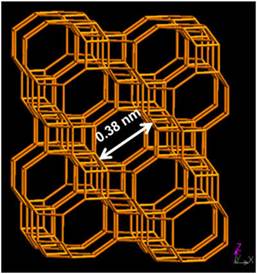
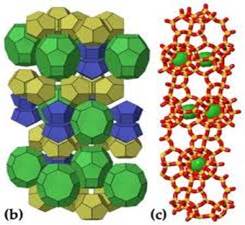
a) CHA B) DDR
Example Usage
Zeolite 13X beads uses 2 vessel configurations for biogas separation with pressure driven requirement. Zeolite membranes with multiple modules configuration use 2-stage/3-stage technique during the Biogas upgradation. In the first step, CO2 molecules are caught under high pressure until the Zeolite membrane is saturated at permeate stream. In the second step, the zeolite membrane is pressurized, whereupon CH4 molecules are released in higher concentrations at reject stream. Then, depending on the application these gas molecules are then collected in a separate gas chamber/gas holder for desired application.
Benefits
- Mechanical and thermal stability compared to existing solutions
- System is flexible and capable of handling low percentage of methane slippage handling very high concentrations of streams
- Capable to produce large reactors with high flux and high selectivity
- The patented coating process without crack formation and minimizes other non-selective defects
Business Plan and Investment
NxTBrane India Pvt Ltd is startup based in Mumbai. Maharashtra Minerals Corporation (MMCL) has been engaged in the business of mining, mineral processing and marketing of mineral products since 1962. Application mentioned above is protected by patent and NxTBrane is a license holder. NxTBrane India Pvt Ltd and MMCL are currently working to deploy a pilot plant to produce the material by 2027.