
High selectivity o-/p- xylene separation
Executive Summary
Para-xylene (p-xylene or PX) is the foundational chemical feedstock required to produce Purified Terephthalic Acid (PTA), which is subsequently polymerised to manufacture polyester fibres, packaging, and clothing. However, industrial PX production inevitably generates a mixture of closely related C8 aromatic isomers. Because these isomers act as highly detrimental impurities in downstream polymerisation, achieving ultra-high purity PX is non-negotiable for the synthetic fibre industry. Traditional separation methods are severely constrained by extreme energy requirements and volatile raw material costs, prompting a major industry push toward next-generation membrane-based molecular sieving technologies
Market Overview
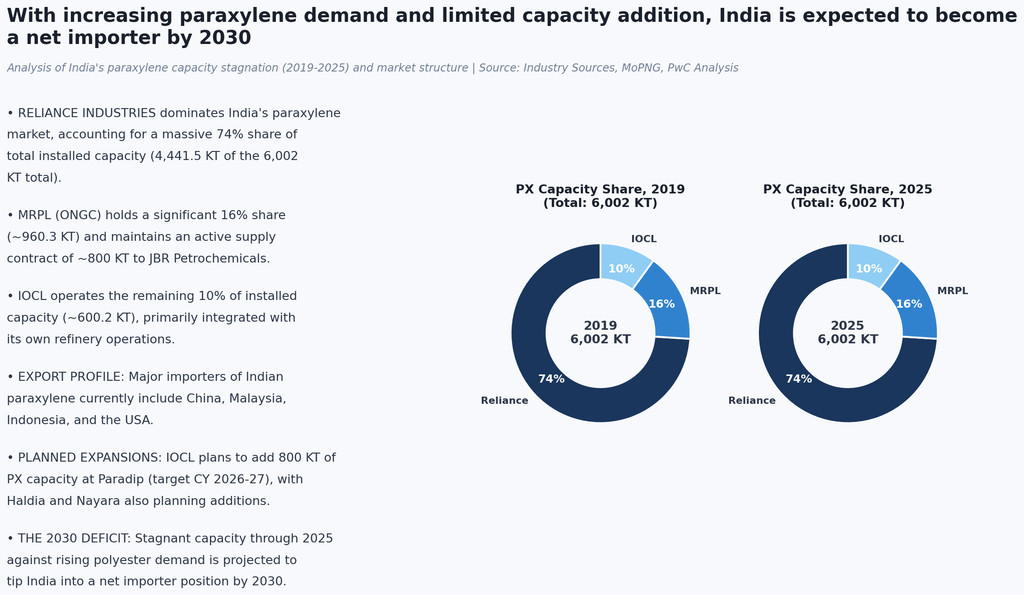
Technology Introduction
There is a great need for robust, defect-free, highly selective molecular sieve (zeolite) thin film membranes within separation of aromatics such as p-/o-xylene separation. Current separation membranes are based on Pt, Pd, Ag, Rh alloys or on chemically and mechanically unstable organic polymer membranes. The use of molecular sieves brings a stable (chemically and mechanically stable) inorganic matrix to the membrane. The crystalline frameworks have “tunable” pores that are capable of size exclusion separations. The frameworks are made of inorganic oxides (e.g., silicates, aluminosilicates, and phosphates) that bring diff erent charge and electrostatic attraction forces to the separation media. The resultant materials have high separation abilities plus inherent thermal stability over 600°C and chemical stability. Furthermore, the crystallographically defined (<1Å deviation) pore sizes and shapes allow for size exclusion of very similarly sized molecules. In contrast, organic polymer membranes are successful based on diff usion separations, not size exclusion. Therefore, Zeolite based Thin Films (< 50nm thickness) are far more eff ective in lowering the cost of the system by replacing precious metals, being able to cover large areas and increasing selectivity, flux and significantly saving energy in chemical production
Approach
Molecule structure is MFI based. Membrane structure, coating thickness was determined using
● SEM (Scanning Electron Microscopy),
● AFM (Atomic Force Microscopy),
● XRD (X-ray Diff raction),
● TEM (Transmission Electron Microscopy)
Example Usage
Zeolite membranes use 2-stage technique during the separation of aromatics. In the first step, VOC molecules are caught until the Zeolite membrane is saturated. In the second step, the zeolite membrane is heated, whereupon the isomers are released in higher concentrations. Then, depending on the application these isomers are then collected in a separate chamber or incinerated.
Benefits
● Mechanical and thermal stability compared to existing solutions ● System is flexible and capable of handling low concentrations of VOCs in combination with very high concentrations
● Cost eff ective compared to the current precious metal catalytic systems
● Capable to produce large reactors with high flux and high selectivity
● The patented coating process without crack formation and minimizes other non-selective defects
Business Plan and Investment
NxTBrane India Pvt Ltd is startup based in Mumbai. Maharashtra Minerals Corporation (MMCL) has been engaged in the business of mining, mineral processing and marketing of mineral products since 1962. Application mentioned above is protected by patent and NxTBrane is a license holder. NxTBrane India Pvt Ltd and MMCL are currently working to deploy a pilot plant to produce the material by 2027.